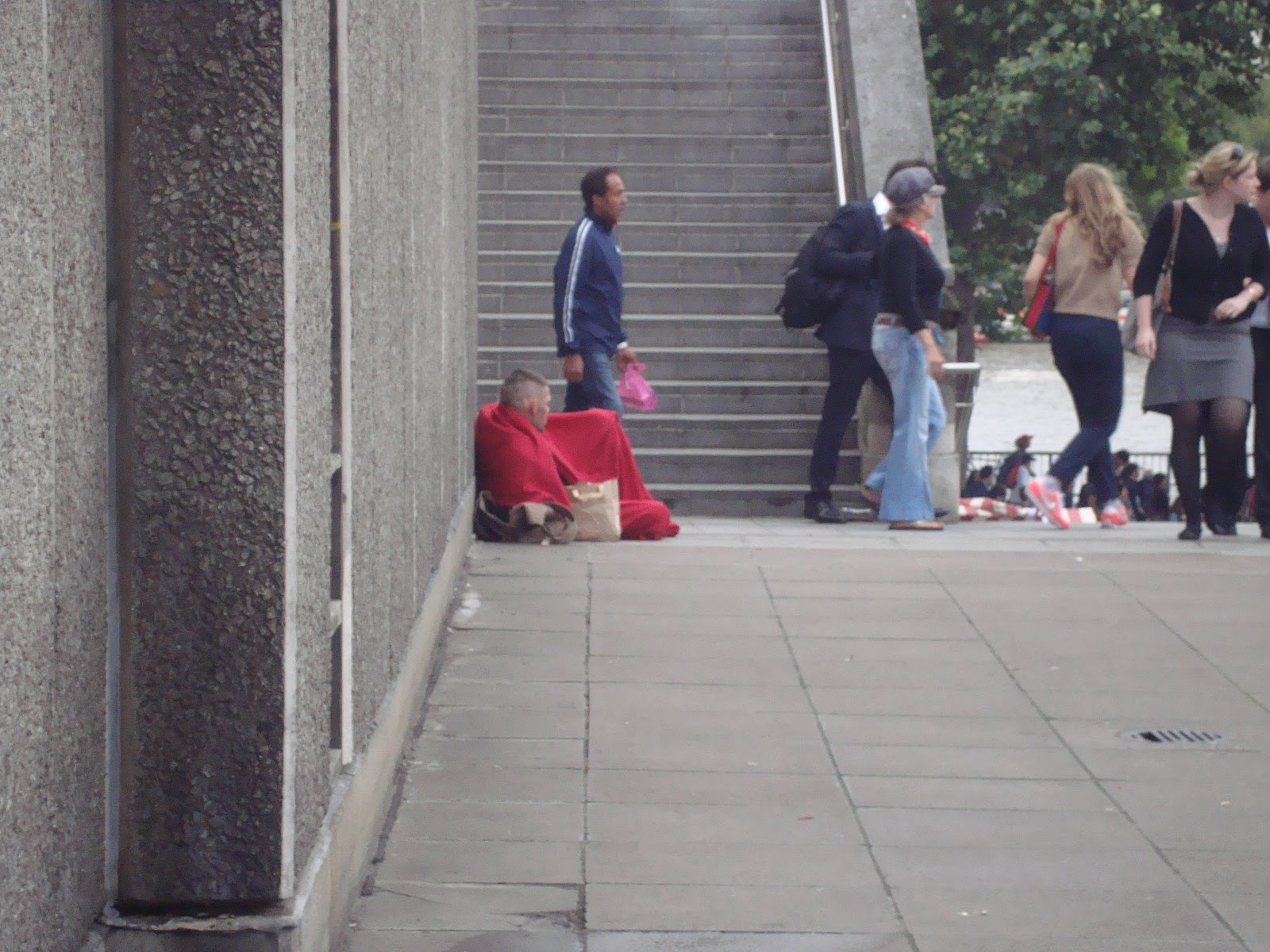
They don't exist in the catalogue versions of the city. You never see them on BBC or TripAdvisor's coverage of London. Jet-setting friends return without ever making any mention of them, yet in the actual city you come across these homeless everywhere. They are nowhere near in number to the throngs of beggars that crowd the traffic signals of Lahore, but the impact of their loneliness, guilt and visibly broken spirits is somehow greater on the soul. Perhaps because the beggars in Lahore are usually assertive, soliciting money actively, even aggressively, tapping on car windows with force, sometimes even throwing the coin right back at you if it doesn't live up to their expectations. In London they just huddle on the edge of a tube station or street corner trying to shield themselves against the city's cold evenings, feebly calling out to passersby for a coin; many too ashamed to attempt even that. They invariably wear a far away, glassy look and an acute sense of having failed in a world that lays so much premium on winning. It is perhaps the contrast with their surroundings that makes their plight more readily moving, or it could be my personal immunity to the everyday sufferings of our own poor, part of an endemic cycle of injustice and hardship that everyone but the very elite are protected from. I fear romanticizing their plight, but in Lahore, beggarwomen often form a curbside community of females more loose-limbed than their middle class counterparts, their children tearing about on roundabouts, fighting and sometimes laughing amongst themselves, living some form of community on the very fringes of society. London's homeless, however, exist in complete isolation.
On Millennium Bridge
Holborn. I could have taken another, less fuzzy picture, but it seemed callous to let him catch me photographing him, so I just made do with the first click. The manner in which he just sits there conveys enough.
Behind Embankment
A woman sleeping on the pavement near King's Cross Station
You 'might enjoyed' this sign at Waterstones, Islington
'Tradisional' English breakfast at Pimlico
Methinks someone from Hafeez Centre is trying to make it in Hackney
Coinage by a Central London cafe, possibly to encourage the pleasures of loose tea. Hoping they're as mindless of the UrbanDictionary meaning as they are of its spelling.
All Behaviour Relating...Of a Sexual Nature ...Or of Illegal Activity?
The ostensible reason for coming to London a few days earlier than required was to settle down a bit before my course began, but really it was just for Wimbledon. I had a very small window of opportunity before the daily grind began and I wanted to be able to grab it.
A Stefan Edberg/Boris Becker Wimbledon final in the 80s first brought tennis to my consciousness, after which the cool whites and greens became an annual harbinger of joy. Despite being the only channel available, PTV managed to provide quite a variety of sporting entertainment back then. Besides the obvious like cricket and hockey, it showed football world cups, Olympics events and live telecasts of Wimbledon finals, both gentlemen and ladies. In those 11 schizophrenic years of Zia where it was mandatory for a PTV announcer to wear a dupatta on her head, there was also Musarrat Nazir tossing her lustrous tresses on a psychedelic disco set and Martina Navratilova and Steffi Graff working their short skirts and rackets into the collective Pakistani consciousness.
So Wimbledon was a place of romance for me since childhood, right up there with the England of Enid Blyton's creation. Andre Agassi hitting a ball in mid-air on a Wimbledon court occupied the post above my bed (at a time he still sported long locks and a rockstar image) and life-lists in floral teenage diaries included watching Andre Agassi play a Wimbledon final live. Once Agassi retired, I transferred my affections and dreams to watching Federer play a final on Centre Court instead. So I wasn't going to miss the opportunity now that everything was aligned--I had a visa, I was in England and Wimbledon was on!
I arrived in London on the 27th of June and decided to attend the next match Federer was playing on the 29th. One of the best things about Wimbledon is that it reserves tickets for tennis fans who want to queue on the day, so there is no tension (or convenience) of acquiring one through dubious means. The catch, however, is that you need to queue overnight to get your hands on the limited number of tickets available this way. So, on my second day in the city, I packed my backpack and set off on the long trek to Wimbledon on the London Underground.
My brother decided to come along till Wimbledon station so I wouldn't get hopelessly lost on my way, but thanks to our spontaneous detour at St. Paul's Cathedral (about that in the next post) he got really late and had to head back home before the last tube, which meant I had to make my own separate way to Wimbledon. As I stood on the platform watching my brother's back recede I experienced a range of emotions from trepidation to a sense of novelty at the freedom to stand all alone late at night in a big city, about to embark on a midnight adventure.
At 12 AM I got off at Southfields Station (the right station for the Wimbledon Tennis Courts instead of Wimbledon Station itself) outside a quiet market square with little signs of activity besides a few people at a late night corner pub across the street. A man I asked for directions quipped, "You're a bit late for the matches' but pointed me in the general direction, which I dutifully followed up a road with rows upon rows of small, posh gate-less houses. The farther I went, the quieter and steeper the streets became, with just one woman with a dog walking behind me to provide some sense of comfort. After she too turned into an alley, I stopped, confounded and with no clue where to go next. Fortunately a few people passed by who informed me I needed to go back to the subway station and take a different road from there.
After a long trek downhill I reached the Southfields Station again, this time taking the road from the pub which eventually led to a couple of official-looking people standing on the pavement. I asked them about Wimbledon tickets and one of them shone a torch into the pitch darkness ahead of him which was met with an answering torch beam from what seemed like very far away. Walking in the direction of the beam I reached an official who cheerily informed me that I was the 943rd person in the queue and that meant there was no chance I was going to be able to get a Centre Court ticket in the morning. I could hope for a Court 1 at best and a grounds ticket at worst. For the uninitiated, Federer, the 6 times Wimbledon winner is given the respect of always playing on the grandest court in the grounds, Centre Court, so that essentially meant the reward for an all-nighter would be a half-Wimbledon experience. Yes I wanted to see Wimbledon, but Wimbledon without Federer is like strawberries without cream (unimaginative analogy I know, but at least it sticks to the theme). Considering how late it was by then, the decision was made for me, there was no going back. There was also the naive hope that I would still somehow manage to wrangle my way into Centre Court, after all I was the same person who had elbowed her way to the front row of a Junoon concert as a teenager, darned if I was going to let my old age get in the way of my desi fighting spirit now. I nodded my resolve to go on, but before waving me off the security guard asked if I had my camping equipment on me.
'Camping equipment? But I thought you could rent it on the grounds'.
Turns out you couldn't.
Peering into the darkness, I trudged on to the vast camping grounds dotted with a sea of tents--a mini-Mina of sorts, where I was escorted to the end of a snaking 'queue' of nine hundred and forty two tents. On my left, two young Indian men huddled over a phone, announcing to their friends that there was no hope of seeing Federer even if they stayed in the queue the whole night. On my right a man toiled to set up a tent, grunting and muttering to himself in, what to my unpracticed ears sounded like Japanese, as I dropped my backpack on the grass and lay down on its wet surface, backpack for pillow, marvelling at the stupidity of not even bringing a blanket to spread under me. The warm weather of the morning had fooled me into thinking I could just spend a night under the open sky without any protection, innocently unmindful till then of the treacherous nature of the British 'summer'.
It had become unmistakably chilly by the time the Indians decided to abort their quest and the Japanese managed to put up his tent and duly disappear within it. In fact, it was so chilly that I knew I wouldn't be able to survive the night in only my jeans, t-shirt and thin, half-sleeved sweater. I zipped open my backpack, fished out my other pair of jeans and wriggled into them over the pair I already had on, wrapping a flimsy cotton top around my ears to stop the freezing cold from seeping into all my joints and pores. It hardly made any perceptible difference. It was cold enough to qualify as a January night in Lahore but with added wind chill.
I can swear that along with my fingers, the hands on my watch also froze between 2:30 and 3:00 while I tried to inch my way nearer to the Japanese tent in the hope of finding some residual warmth. By 3:00 I was desperate enough to produce some strategically loud sniffs in the hope of rousing the chivalrous spirits of fans of a famously gentlemanly sport, but was only met with sounds of people shuffling underneath their warm tents trying to make themselves more comfortable. When I had dreamed of going to England and living the setting of so many of my favourite stories, I hadn't quite had Eliza Dolittle and The Little Match Girl in mind. But that was how it was, and thus I spent the whole night, occasionally walking around to try and stay warm with little to no effect.
Streaks of dawn began to appear on the horizon by 4:00 and the guards on duty told me they would start waking up everyone by 5:30. One of them took pity on my shivering state and suggested I go to the bathrooms for some respite from the biting wind. The makeshift bathrooms at the opposite end of the field were surprisingly clean and even a couple of degrees 'warmer' but there is only so long one can stay in a loo. By the time I returned to my spot I was so exhausted, cold and bleary that I would have forced my way into a tent at gunpoint if I had to. Fortunately for others this wasn't the US.
I think my plight finally transmitted itself to my neighbour who poked his head out of his tent and asked me in half sign-language, half mumbo-jumbo if I wanted to come inside the tent. I swiftly calculated the possibility of a Japanese tennis-tourist turning out to be a molester but decided that by this time I was past the stage of caring. Next thing i knew I had crawled inside his tent and was lying gingerly on the edge of his air mattress. He turned out to be quite the gentleman and exited the tent soon after, leaving me to finally collapse into an exhausted stupor before the guards woke everybody up and nudged them into a tighter queue.
In a couple of hours the whole site was abuzz with morning activity and sounds of tents being folded all around, while I tried to prolong my fitful sleep a bit longer by resolutely keeping my eyes shut. The air remained as chilly as the night before and the clouds above loomed dark and threatening. My tent friend hurried off to check up on his car leaving me in charge of his things, including a cell phone that kept buzzing while he was away. It had to be the most bizarre situation I have ever found myself in, and I have been in some. Upon his return I hauled myself out of the tent and tried to talk to him as naturally as one can to a stranger you just slept next to in a tent. The awkwardness of the situation was mercifully defused in the quest to join the corners of the tarpaulin and stowing the tent away neatly, when suddenly I noticed that there was nothing Japanese about either the man's features or his accent. Turns out he was French. So much for my nationality molestometer! And then we held hands, walked off the grounds and zipped around Europe for the next month, arriving in Pakistan in due time to feast on family blessings and copious amounts of laddu; bought a mountain chalet in Switzerland and lived happily ever after.
No? Well, no! This is not THAT kind of story, though truth IS stranger than fiction as you shall soon find out.
As I stood shivering on the side and a fresh gust of chill wind hit me, the cold and the exhaustion became overwhelming and I decided I had had enough dream-chasing for a lifetime, and the only one I cared about any longer was one involving a warm duvet and a bed. So with the single minded pursuit of the guestroom at my brother's place I power-walked my way right out of the grounds and on to the Southfields Station. French dude had gone off in pursuit of his car again and I didn't feel there was any particular need for me to inform him of my change in plans.
On the train platform I began to have second thoughts. The night's tribulations nagged at me and it seemed ridiculous to leave when I had put up with so much already. Yet I knew I needed a warm jacket to survive the day. Catching pneumonia for a ladies match on Court 1 two days before my classes were to start did not seem like a good bargain. I asked a uniformed man if there was any place near I could buy a jacket from and he pointed me to a very Pakistani looking uncle manning the station newsstand, 'He knows everything there is to know about this area'. With that ringing endorsement I approached the man who told me no place would be open so early in the morning, but slipped in the reassurance that it would soon start getting warmer and that I should probably make my way back to the grounds. Something in his confident manner convinced me to brave the day anew, and I decided to return to the Wimbledon grounds.
There the scene had now transformed. Everyone was packed together in a long queue and things were humming along. My queue card allowed me to jump the line to where I originally belonged. Standing together like that with so many other hopefuls, the whole effort felt far less futile. Sure enough the temperature also started to improve.
I found the friendliest people of my stay in England in that queue. The jovial, party-like atmosphere encouraged conversations and helped make the wait far less painful. It was also there that I learned the biggest news of the day, that Rafael Nadal had crashed out of the tournament after a second-round defeat the night before. I also discovered that Aisam-ul-Haq would be playing in one of the grounds courts that day, a singularly cheery prospect. If there was going to be no Federer at least I could salvage the ticket price by cheering for my country.
Chattering with an Irish couple behind me, I suddenly noticed my French guy make a reappearance through the crowd. I cheerfully stepped aside to make room for him as he strode up and asked,
'Do you have my tent with you?' Not quite the question I was expecting.
'Tent?'
Racking my brain I hazily recalled him leaving to check up on his car right after I had helped him pack up his equipment. But how was I supposed to explain to someone who barely understood any English that I was feeling nauseous with cold at that point in time, had dropped my lifelong dream of attending Wimbledon altogether and nearly sat on a train and left, and that his tent was the last thing on my mind when I'd shuffled off the ground in a fatigued haze. I just stared at him, while his accusatory glance almost made me feel up my clothes to make sure I had not indeed poached his belongings. After several vehement shakings of my head, wild gesticulations and many sorry-i-have-no-clue faces he disappeared back into the crowd taking my morning's buoyancy with him. Such a bummer that he had to be rewarded for his kindness with the loss of his things and even greater bummer that, if not stealing, I could at least be genuinely accused of thoughtlessness. He showed up again after some time to tell me that nobody knew anything about where his things had disappeared, not even the officials, and I once again found myself in the position of protesting my innocence. After that he just disappeared and did not return to the queue, although his number was one ahead of me. I have a feeling he abandoned the grounds altogether. Bollywood won't be knocking on my door any time soon for scripts, I guess.
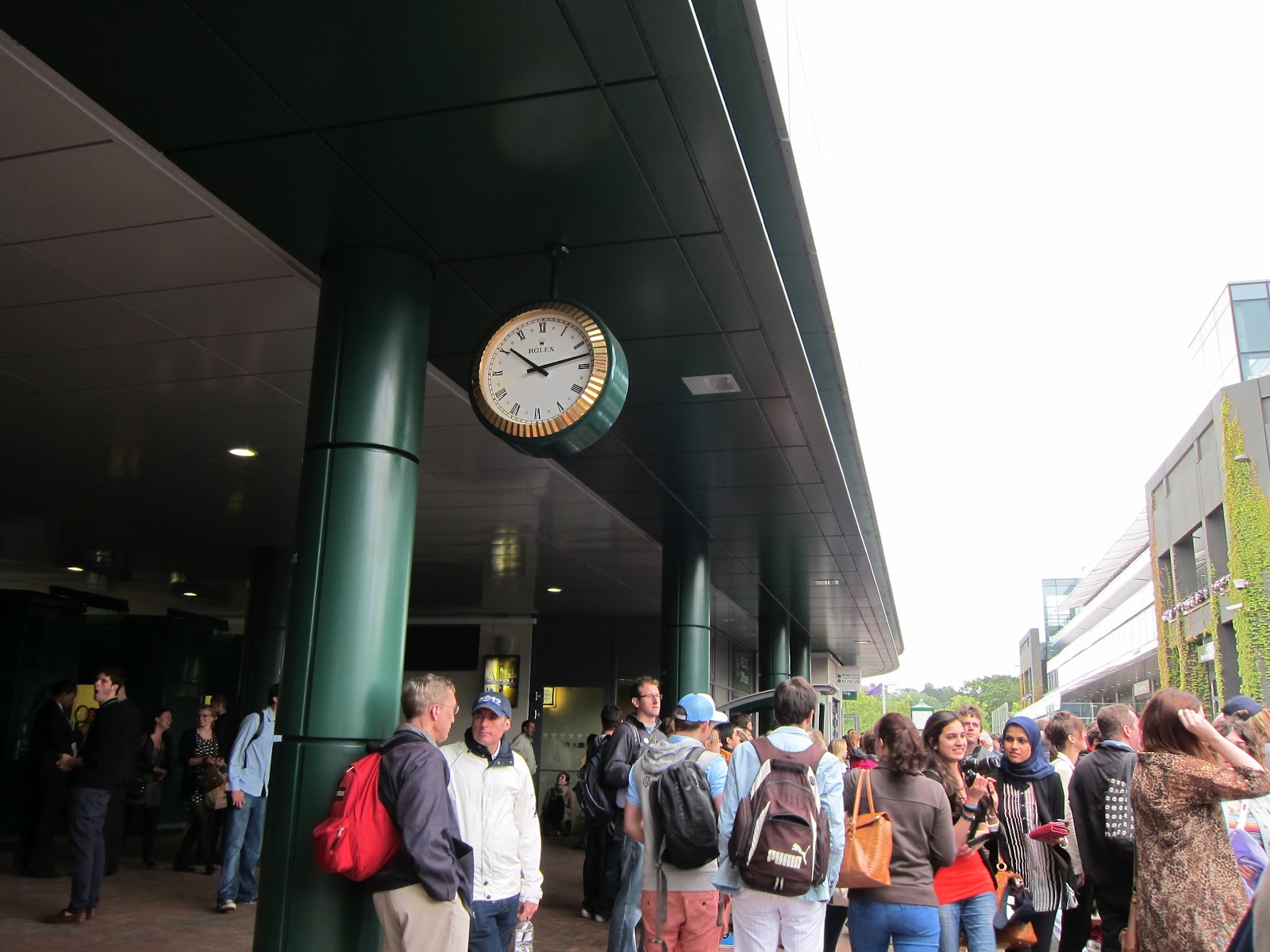
Soon after, an official started handing out wrist tags to people in the queue. Purple for the Centre Courters, orange for those who would make it to Court 1 (that's me!), and other colours for Cort 2, 3 and the outside courts. The queue then started inching along a lake and over a bridge streaming Radio Wimbledon from sleek white speakers fitted discretely into its steel, green structure. It seemed solely obsessed with Andy Murray's progress in the tournament, but still, it was Radio Wimbledon and I was listening to it on the hallowed grounds of Wimbledon itself.
Walking on the bridge I suddenly found myself right in front of what is the 'actual' Wimbledon, that iconic Star Sports image of charcoal buildings fronted by a riot of purple and white Petunias that year after year has marked the joyful arrival of summer for me. I stood and gazed upon it for many seconds, just basking in the wonder of my being there, and shedding some involuntary tears. Only one other thing moved me in the same way in my month and a half in England. But that's a story for another day.
The first view, though this is a picture taken later from within the grounds. The first glimpse was too special for me to bother with a camera.
A little something to be proud of as a Pakistani
Where I bought the Wimbledon insignia T-shirt for Talha and a purple & green Wimbledon umbrella that I lost in the tube a couple of weeks later :(
Nice name for a Wimbledon cafe
Instead of going into Court 1 and watching Sam Querrey vs. Milos Raonic, I chose to stay on the outside courts. I first got to see the thrilling sight of Novak Djokovic (my second favourite player on the circuit) come practice on one of the outside courts. I had seen both him and Federer six months ago at an exhibition tournament in Abu Dhabi, so it wasn't completely novel, but still Wimbledon is Wimbledon. Djokovic is so much more tall, thin and wiry in person. On television he comes across as more beefy.
After Djokovic left I scrambled to grab a good front row seat on Court No. 4 for the Aisam-ul-Haq/Jean Julien-Roger doubles match, unfortunately marred by numerous rain interruptions and some bulls-in-a-china-shop-type American 'fans' with whom I had a little side cheering-match of my own. One 'expert' from among them was informing the large group about tennis's point scoring system while they cracked loud jokes about American football. They were almost like a parody of Americans in England. I had a rather jolly time looking my real-Pakistani-tennis-fan nose down upon them. The Brits around me, equally true to their character, maintained polite poker faces. After cheering Aisam on to a first set win, I lost patience at his second set loss and decided to use my hard-won Court 1 ticket instead. (It was only the next day that I found out that Aisam had won that match)
Court 1 had two back to back ladies' singles matches. What a yawnfest! As far as I am concerned ladies tennis has been nothing but a disgrace since Steffi Graff, failing to generate a compelling narrative or a truly dominant champion ever since. In normal circumstances I wouldn't go see a ladies match free, but here I had paid £60 and needed to 'halaal' my money. By the time I entered Court 1, the clouds had disappeared and it was bathed in sunshine. I had an amazing seat that was barely two rows away from the action and it was so Wimbledon-y, so stately, that once there, I felt a lot less peeved about not being able to make it to Centre Court. Not only did I get my money's worth but Court 1's splendour, my great seat, and the obviously knowledgeable crowd made the experience way above and beyond my expectations. Also, if there is any ladies player I would like to see amongst the current crop, it is probably Maria Sharapova. Even women find it hard to resist such leggy, blonde beauty. Even though the ones behind me seemed to hate her with a vengeance, bitching about her grunting, and managing to find something crafty and devious in the slightest twitch of her finger. I thought she played some powerful and beautiful tennis, as did her opponent.
Even then, I slipped out once Sharapova advanced, to take in the sights and sounds of other outside courts. Each one had its own unique feel that no other court could replicate. Some sunken like Greek amphitheatres, others high up on a hill, yet others proudly proclaiming their glorious past:
And of course Henman Hill, which much to my surprise, even officials on the grounds referred to as that. I guess things will change next year after Murray's golden feat.
During my wanderings I found out that there is still a bright chance of getting into Centre Court. Federer's match was the last match of the day and a lot of people who have day passes to Centre Court leave towards the end and surrender their tickets at the gate for others to be able to enjoy. These returned tickets are resold at a price of £5 only and handed out to people who stand in a queue at a designated area opposite Henman Hill. Once I found that out I dropped all plans of returning to Court 1 to see Kim Clijsters and went and stood in the queue. Volunteers, who were friendly and honest with their advice, told me that I should return in an hour by which time the tickets would start pouring in and there would be a high likelihood of getting into Centre Court. When I returned at 6, Federer's match was well into the first set and the queue for the debencture tickets (that's what it sounded like, debencture) was snaking many miles long. Even then the volunteers were confident that I would be able to find my way into the match, 'Just hope that Federer loses at least a set'. Meaning thereby, that if the match ran a little longer there would be greater chances of 'experiencing Centre Court', as he put it.
But before I could go the legitimate route, a man walked past calling out,
'Anyone wants to go in alone? I have one ticket'
'Me! Me! Me!'.
He came over and quoted a price that didn't sound too exorbitant, I think something around £30. The rather upright British woman in front shook her head but I felt little moral qualms as I shelled out the cash hastily. Selling tickets in black is a frowned upon business inside Wimbledon, as well as hard to pull off around a network of officials, volunteers and security. But this was Federer, and I don't go to Wimbledon every day and Federer isn't getting any younger. I wasn't about to let that go for some dubious higher moral ground. Resolutely avoiding the lady's disapproving gaze, I grasped the ticket firmly and skipped out of the line straight toward Centre Court.
What a magnificent sight. The closed centre-court roof.
The Centre Court atmosphere was electric under a closed roof where I sat next to a sweet, old British lady who gave me all sort of tips for my stay in England, despite my rather unfortunate opening question, 'Are you French?' I assumed anyone who was not clapping effusively for every Federer point had to be. Her response, 'Good heavens, no.' Haha. She was as British as they come.
Well, Federer didn't just lose one set, as the volunteer had asked me to hope, he lost two in a row, and it took all my doing to bring him back from the brink. There was some hard work to be done like joining in chants of, 'Let's go Roger! Let's go! *clapclapclap*', while shouldering the burden of getting him through with lone encouraging shouts at other crucial junctures. Roger eventually pulled through in five sets in a thrilling contest and especially mentioned the crowd's support in his post-match conference. What an amazing way to round off the day.
On to the 4th round (and the title)
That's me surveying the grounds at the end of it all
I came out of the grounds to fading light, processing the events of a thrilling twenty four hours with every step that took me away and on to new adventures, none of which, I was sure would surpass my very first days in England.
London is enormous. It is a living and evolving city, which makes it very different from the city of my romantic imagination. I think I exoticized London in a way many Westerners are accused of exoticizing the East. I expected it to be a quaintly preserved slice of ancient history, but it turned out to be a complex and sprawling modern mass that is impossible to make sense of if time is scarce. Probably the reason why it took me nearly a month to warm up to it.
It may also have been because my first month was spent going up and down the Strand, mainly in constantly rainy weather that didn't let up for a minute. I didn't even know that The Thames and the Southbank were right behind me every single day that I got off at Holborn station and walked to the King's College Campus. So a small section of Holborn and the Strand became my London. The times I did venture out, I took the tube, which blinded me to any sense of real direction. Then one day a couple of course mates suggested a sojourn to that haven for the broke--Primark. They simply came out of King's, kept walking down the road, and much to my surprise hit Oxford Circus in no time. I had no clue Oxford Circus was that near. I would always dutifully walk back to Holborn and get on the Central Line to reach what I considered 'the real Central London'. Turns out I was in it to begin with.
These trips to Oxford Circus, Piccadilly and thereabouts shaped my first impressions of the city, and their massive celebration of Capitalism left me mostly alienated and bemused. Street upon street of all the big brands that you find in Dubai Malls, with not a local boutique or business in sight. It made me marvel at the glib hypocrisy with which Western media outlets condescend to Dubai's commercialism. The shopping districts of London are no less crass or frenzied. But of course there is a London beyond the quadrangle of Bond, Regent, Oxford and Piccadilly, and thank Heavens for that.
My sister-in-law, who is a Londoner, took me to King's a couple of days before classes were to start so I could get a hang of the London underground. Once there she took my little niece for a nappy change to a loo within the campus building. We went up and down the whole place without anyone bothering about who we were and what we were doing. This liberty to so freely wander an educational institution triggered a mixture of bitterness and nostalgia. Having seen LUMS become an impregnable fortress right before my eyes I marvelled at the unchanged way of life for people in the West compared to the manner in which Lahore has been totally crippled post 9/11. Hanging there all easy-like at the Strand Campus, the irony of the twin towers' ghosts coming to haunt Lahore more long-term than NY or London seemed inescapable. Despite the recession they continue unabated as the great cities of the world, while crippled Lahore has just gone from bad to worse.
Last night was a crazy ride. Danny Boyle reinvented the game by shunning the generic, synchronized Olympic-opening-ceremony, and creating a zany combination of cinema, theatre and music in a tumultuously British extravaganza.
And I was there for it! Well, almost.
My sister-in-law's parents had bought a flat 12 years ago in this part of East London where the Olympics are being held. At the time the place was mainly a dump. Then came the Olympics announcement and a regeneration of this area. Uncle and Aunty were hoping to rent out the flat to tourists coming in for the games but that did not materialize, and so it came to be that we ended up on the eve of the Olympics on a balcony which faced the Olympic Arena. There were several flats in the same building that had no view of the stadium, so ours was a double stroke of luck.
We set off from our house in Hainault at around 6pm and got off the tube at Stratford Station from where the walk to the flat building was about 15 minutes. My Londoner sister-in-law exclaimed at every turn over the transformation the area had undergone as we walked our way to the flat.
Strings of light balls along the way
Spanking new block of flats. Dig the black and purple design.
A view of the Olympic Park on our way to the flat
For us the games began (as we raced against time to set up the television in the empty flat) with a noisy tri-coloured jet salute right above our heads at 20:12
The television was set up a few minutes into the the show and placed out on the balcony with the Olympic stadium as backdrop.
Taken from our balcony this picture shows a Pakistani flag on the left of the picture.
The ceremony, clunky and odd at first had me sold by the time the Industrial Revolution rolled around. A lot has been written about the ceremony, but no one's mentioned the reference that first came to my mind when I saw them erecting those giant chimneys: William Blake's bleak London of little chimney sweeping boys doomed to a future of lung diseases and death.
Here are his 'Chimney Sweeper' poems, the first from the Songs of Innocence and the Second from Songs of Experience:
"The Chimney Sweeper," from Songs of Innocence
When my mother died I was very young,
And my father sold me while yet my tongue
Could scarcely cry " 'weep! 'weep! 'weep! 'weep!' "
So your chimneys I sweep & in soot I sleep.
There's little Tom Dacre, who cried when his head
That curled like a lamb's back, was shaved: so I said,
"Hush, Tom! never mind it, for when your head's bare
You know that the soot cannot spoil your white hair."
And so he was quiet, & that very night,
As Tom was a-sleeping he had such a sight!
That thousands of sweepers, Dick, Joe, Ned & Jack,
Were all of them locked up in coffins of black.
And by came an Angel who had a bright key,
And he opened the coffins & set them all free;
Then down a green plain, leaping, laughing, they run,
And wash in a river and shine in the Sun.
Then naked & white, all their bags left behind,
They rise upon clouds and sport in the wind.
And the Angel told Tom, if he'd be a good boy,
He'd have God for his father & never want joy.
And so Tom awoke; and we rose in the dark,
And got with our bags & our brushes to work.
Though the morning was cold, Tom was happy & warm;
So if all do their duty, they need not fear
"The Chimney Sweeper," from Songs of Experience
A little black thing among the snow,
Crying " 'weep! 'weep!" in notes of woe!
"Where are thy father and mother? say?"—
"They are both gone up to the church to pray.
"Because I was happy upon the heath,
And smiled among the winter's snow,
They clothed me in the clothes of death,
And taught me to sing the notes of woe.
"And because I am happy and dance and sing,
They think they have done me no injury,
And are gone to praise God and his Priest and King,
Who make up a heaven of our misery."
At least for me, the haunting pain of these poems seemed to loom over the chimneys in the Olympic Stadium. As the chimneys started morphing into furnaces powering the Industrial Revolution with an army of men pouring forth from the bleak environment, I was reminded of Dickens' Coketown from Hard Times:
It was a town of red brick, or of brick that would have been red if the smoke and ashes had allowed it; but as matters stood, it was a town of unnatural red and black like the painted face of a savage. It was a town of machinery and tall chimneys, out of which interminable serpents of smoke trailed themselves for ever and ever, and never got uncoiled. It had a black canal in it, and a river that ran purple with ill-smelling dye, and vast piles of building full of windows where there was a rattling and a trembling all day long, and where the piston of the steam-engine worked monotonously up and down, like the head of an elephant in a state of melancholy madness. It contained several large streets all very like one another, and many small streets still more like one another, inhabited by people equally like one another, who all went in and out at the same hours, with the same sound upon the same pavements, to do the same work, and to whom every day was the same as yesterday and to-morrow, and every year the counterpart of the last and the next.
These attributes of Coketown were in the main inseparable from the work by which it was sustained; against them were to be set off comforts of life which found their way all over the world, and elegancies of life which made, we will not ask how much of the fine lady, who could scarcely bear to hear the place mentioned.
While we are on literature, the immense joy of seeing Rowling, and the fallout of holding an opening ceremony party, meant I really couldn't catch any of what she said. Nonetheless her placement within the NHS/bed segment seemed very smart to me, not just because that segment was intrinsically tied up with children, storytelling and the battle between good and evil but also because Rowling's own charity (now called Lumos) helps in taking institutionalized Eastern European kids who sleep on caged beds out of their miserable circumstances.
As for the rest. There isn't much that hasn't been covered by many of the brilliant reviews that have been published since yesterday. One bit of of one of these reviews (by Chinese artist Ai-Weiwei) left me staring into space for a long while:
A nation that has no music and no fairytales is a tragedy
---
A lot of social media debate was generated over why the Pakistani contingent did not smile as they marched around the stadium. Having spent the past month in London and the past 33 years in Lahore, I think I can tell why. First of all, in the international arena right now Pakistan is probably one of the most reviled places in the world. Just to be a Pakistani is to be guilty of some unknown crime you haven't committed but are still accountable for. That places people who have done nothing wrong under a great deal of pressure. When the only images that are beamed out of your country are of bomb blasts, terrorists and donkey carts, then marching down that track does not remain as simple and joyous as it does for countries with lesser burdens to bear. Suddenly that 15 seconds of camera time becomes your only face to the world. In cricket we know we will do well, will have the opportunity to show our mettle on the field; there will be enough time to reveal ourselves as real people and allow crowds to be part of our narrative. In the Olympics we haven't won a medal since 1992. That means there is little chance of Pakistan managing to project its complexity by involving crowds in its narrative through noteworthy success on the playing field. That 15-second march is everything. Imagine yourself in that position and then try doing the bhangra. Also, think of the nation's general make up. Most people belonging to middle class families believe that the 'decent' way to behave when the world is watching you is to look respectful and deferential. Ours is not a country that smiles in the face of cameras, we pat down our hair and stand up straight. Relaxed smiles and knowing how to work the camera are traits that spring from lifestyles replete with opportunity and confidence. That is not the strata most of our athletes or most of our nation belongs to. I was proud of them, especially the flag bearer, one of the greatest hockey players Pakistan has produced in its recent history and of Anum Bandey who despite not being able to qualify for the next round broke the Pakistan record in a swimming event today. Salute to their courage and resilience. It can't be easy to do it against all odds.
First impressions of 'London' were of a city that looked more English than Londonish. Quaint, small English houses, and kids walking back home from school. More like the suburbs of a medium sized town than a busy, bursting cosmopolitan. But I guess it is typical of big cities to have different parts form distinct towns unto themselves--the residential suburbs on the outskirts of the dense corporate centre. On the car ride from Heathrow to my brother's place I saw more desis than Caucasians, which was oddly unsettling. Always takes a while to get used to diversity when you hail from homogenous Lahore. Looking at so many women in shalwar kameezes and dupattas roaming the streets of London made me think of the opposite scenario--non-Muslim, non-Asian women walking the streets of Lahore in their local dresses. The thought made me laugh at its ludicrousness.
I hate airplanes. The putrid smell, the cramped seats (strictly economy) and having to be stationary for hours. Yet with childlike glee (but mostly blissful ignorance of scientific mechanics) I often marvel at how an object so heavy can soar thousands of miles through the air without coming down. Although with a couple of Pakistani planes having crashed in the last few years, even that assurance has somewhat waned. Each little lurch can be an instinctive prompt for long memorized (and now long forgotten) Quranic verses.
There is certainly a lot of truth to the reported deterioration of PIA. The whole experience seems just so much inferior to Etihad or Emirates. Decaying interiors, sour hosts (mostly) and dull in-flight entertainment (playing Bollywood songs under 'Pakistani songs', for one). I am just glad this flight isn't as excruciatingly long as the one to the US.
Flying over Kiev and other such exotic-sounding Eastern European cities the plane finally started descending over the green English hills. From above it looked a bit like Punjab, lush green clearly marked fields, but with small cottages with sloping roofs instead of mud houses. *cue your footsteps will always fall here along England's greenest hills*. Suddenly I felt a bit queasy at the prospect of a long holiday in a country where people from mine have a special slur word reserved for them. That was the thought foremost on my mind as I stared at the immaculately clean tarmac of Heathrow Airport.
The immigration at Heathrow, however, was nice and orderly and surprisingly pleasant to one attuned to passing through UAE immigration. The lines were long but full of smiling faces, unlike Dubai where a sense of fear pervades even the airport queues. Last time it took me 6 hours to pass through Dubai immigration with the menacing policemen and the dour immigration officials all chipping in to provide a glimpse into Arab 'hospitality'.
One of the first things I noticed in the line was an Accenture ad featuring the Royal Shakespeare Company, underscoring the merging of the arts with profit making. A bit like Coke Studio one would think, but without the necessity of 'fusion' to sell it to contemporary audiences.
The line moved quickly and I was waved off to the other side with a cheery 'Enjoy your stay!' by the immigration official. And so there I was, in London.