Showing posts with label Pakistani women. Show all posts

Thursday, February 6, 2014

Where have all the witty women gone?

January 17, 2014


The other night while watching Amy Poehler and Tina Fey conduct the Golden Globe Awards ceremony, I sat in my living room in flannel pyjamas nursing a cold, yet tittering with barely containable schadenfreude at the way single men in Hollywood were played for laughs by two strong, middle-aged women, whose credentials for hosting the awards was not their ability to bare their silky midriffs but their razor sharp wits. In another era the only reaction to George Clooney dating women much younger and Leonardo Dicaprio consistently accessorizing himself with supermodels would have been envious looks and a nudge nudge, wink wink camaraderie among all men concerned (or unconcerned). But there I sat, observing an alternate being thrown up– a reverse ‘slut shaming’, if you will. Even in the west, this irreverent commentary on long established mores of sexual behavior and the subversion that accompanies it has not been easy to come by, nor has it been quick. Having laws that do not discriminate (the right to vote, equal wages etc.) can sometimes be the easier part to negotiate, fundamentally changing the nature of a gendered society’s thoughts and behavior is much harder. Pop culture can often be both a gauge for observing and a tool for bringing about this change.
Who are Tina Fey and Amy Poehler, you might wonder, and why do they matter to an average Pakistani weighed down by too many pressing problems to care about celebrating some abstract feminist victory thousands of miles away in a culture that has nothing in common with us? Well, they matter in exactly the same way as the Suffragette Movement or Marie Curie or The Second Sex matter to me – as markers of important milestones in the history of women.
Even then the disturbing question remains: where are our Poehlers and Feys? In a globalized world I can revel in the jabs these powerful white women make at powerful white men in an industry defined by power and the perception of it, but what about closer to home? As new channels pop up every day in Pakistan’s rapidly expanding media climate, where are our female role models? – The fun, the smart and the witty with a voice unmistakably their own; changing perceptions and creating new norms while still being able to deliver the common touch. What country is riper than Pakistan for such a figure, or two or three?
There was Bushra Ansari once upon a time who gave MoinAkhtar a run for his money and received equal billing, but Bushra was always Anwar Maqsood’s mouthpiece – a perfect receptacle for the parodies, the mimicry and the political satire that Maqsood poured into her, but never a creator. She only brought his vision to life. In fact, going by Maqsood’s recent spate of stage dramas, his representation of women is just a refined version of the Umar Shareef/Hanif Raja brand of comedy – thinly disguised misogyny in the name of humour.
Social comedy, especially of the irreverent and subversive brand, doesn’t seem to have reached Pakistan yet, if one were to go by a cursory surfing of our interminable television channels. One will chance upon plenty of political irreverence but social life is served solely with a heavy dose of melodrama or an occasional side of slapstick. In a rapidly urbanizing country where divorces and single women are aplenty, not a single television show addresses the pleasures and pitfalls of an independent life.
Granted comedy is a difficult genre; what about news channels? Is it too much to ask for a cerebral, rational, erudite woman on television, funny or not? We have Meher Bukhari who mistakes loud decibel levels for a brain. Ayesha Tammy Haq who has a hard time stringing together two sentences of Urdu without stumbling (a matter of importance in a country where to only be conversant in English is to be limited to a very small circle of people). Huma Amir Shah and Sidra Iqbal on PTV World (again in English) have decent shows, but in the stifling confines of Pakistan’s state run media there is hardly any room for cerebral provocation and refreshing new content. Then there are the inane morning show hosts whose sole aim is to outdo each other in their vapidity. There is also the moral brigade ala Maya Khan and the Samaa TV anchor who barges into people’s houses to expose their private lives. This is the extent of our creative bankruptcy. ’57 channels and nothing on’ said Bruce Springsteen. I feel the same sentiment as I flip through Pakistani channels, almost laughing at my expectation of coming across a Fey or a Poehler.

--

Published in The Nation

Sunday, June 30, 2013

Going it Alone

Sabahat Zakariya went to independent candidate Saira Dar's corner meeting and ended up musing about middle class morality and the meaning of these elections

My worn Nokia handset peeled its trademark tune on a drowsy Sunday afternoon. A quick peek identified the caller as one Ms. Saira Dar. Bracing myself to hear the worst from a friend who had been a colleague at Aitchison several years ago and with whom the extent of my relationship ever since has been an accidental run-in at the local cinema, I hit the answer button. A call from a friend long missing usually means one thing, divorce-validation - a service divorcees provide as preliminary counselors and water-testers for those contemplating the plunge. Her monumental news, however, turned out to be of a variety I had not anticipated-a breathless announcement of her candidature from my constituency, NA-125. Full marks on the surprise factor. I have lived in NA-125 for the past 17 years but confusion over voter registration and polling stations has meant I have never cast my vote. This year, with an upgraded NADRA infrastructure, calls for registration well within time and a savvy technological network of verification I am finally in a position to take my politics off twitter and into the polling booth. But getting ambushed by an independent candidate wasn't quite how I had envisaged spending my first precious vote. If personal relations be the criteria then my cousin, the PML-N candidate from my constituency, would be the default choice, but my virgin vote was a responsibility I was taking seriously and I had no intentions of casting it away flippantly.

What she lacked in shrewd political planning, she made up for in sincerity of purpose and the ability to deliver a rousing speech

But vote or no, Saira, the former art teacher-turned politician's is an interesting story. Often in our zeal to talk about the more tangible oppression of rural women, the moral niceties that chain the women of the middle class are overlooked with a swift brandishing of their MA degree as incontrovertible proof of their liberation. Those with any insight know the truth to be far more complicated. The unstated expectations of middle class morality are often as binding as feudalistic and overtly religious expressions of absolute forbiddance. To be a wife and mother who is neither the poor worker nor the Birkin-toting daughter of a rich feudal is to swim in a murky netherland of wifely duties and structured expectations that are incompatible with the fluid energy of political life. The allegiance to the middle class code of conduct is threatened by the personal ambitions of a woman with neither the excuse of avenging her father's death nor the luxury of her family's minions conducting her election campaign for her. Saira told me that her intent was initially met with great resistance by her husband and son, on the pretext that she would end up making a fool of herself, but she persisted -from what I could tell once I met up with her - with considerable personal cost to herself. With her poise and refined convent-girl air it was hard for me to imagine her as a hard-boiled candidate who could get down and dirty in Pakistan's murky political arena, but her story intrigued me, and I decided, out of rather selfish reasons - the need to find out more about my constituency and to make an informed decision about my vote - to follow her on her campaign trail.

The next day I rang the bell of Saira's mother's austere house in a shaded old street of DHA Phase 1. One dupatta-clad woman and the candidate herself ushered me into an echoingly empty house. Her mother was away visiting her son in Dubai, providing Saira with 'a room of one's own' to conduct her affairs away from the domestic pressures and naysaying of her husband's place. Piled into her Cultus we set off for Nishat Colony, one of the poorer neighbourhoods of NA-125, where an old family painter of hers had organized a corner meeting. Poking fun at her own lack of resources Saira felt her low budget would be the key to capturing the people's love and trust. Just as I inwardly scoffed a little at her naivette she made a small joke that illustrated her point well:

'I used to have a Suzuki FX a few years ago and this beggar was constantly bothering me with solicitations for money. A huge Prado stood right next to my car, so I asked her why she didn't go beg from them instead, "Magar baaji ghareebaan nu hee ghareebaan daa dard honda ae na" (but sister, only those who are poor themselves can understand the pain of the poor) came the beggar's reply'. Laughing over this anecdote Saira expressed the hope that a similar kindling of solidarity with the poor would propel her to victory in the elections.

By this time (end of April) she still didn't have any pamphlets or posters and the ones she had ordered were sepia; coloured ones being too expensive to afford. She felt that the only areas she could possibly cover were those with some family or friends of her domestic staff and didn't even hope to attempt to visit her whole constituency. No seasoned political journalist myself, even I could tell that this amount of effort was not enough to win a national assembly seat, but here we were passing through the labyrinthine streets of Nishat Colony, festooned mainly with PML-N candidate Kh. Saad Rafique's banners, going to a poor man's house who apparently had enough faith in the woman to have put together a corner meeting for her. Soon we reached the painter's dimly lit, single-roomed quarters in the middle of a narrow alley. A slightly torn poster of Christ plastered on one wall, a couple of chairs and a charpoy neatly placed beside another, and a verandah with cracked cement floors where a couple dozen relatives and neighbours had converged to hear Saira speak. What she lacked in shrewd political planning she made up for in sincerity of purpose and the ability to deliver a rousing speech without becoming a caricature of the dais-thumping politician. The poor people she had come to address seemed swayed by her ideas that centered on working for the welfare of the poor, providing them with education and the vague but effective promise of returning their dignity to them. Obviously pleased and honoured by her visit, most of the women present immediately pledged their vote; female solidarity, something in her manner or the fact that she had 'honoured' them with her presence being enough to convince them to pledge allegiance, making me marvel at the arbitrary nature of these decisions, amongst the poor as well as the educated middle classes who pride themselves on casting their vote on rational and logical bases but often whose own conclusions are no less instinctive and emotional.

A few of those gathered admitted that PML-N's Saad Rafique had helped build the streets around their area but that they still did not want to vote for him since he hadn't 'shown his face' to them in the past five years. As Saira spoke about the need for universal education a man piped up to say that the young lad standing next to him had completed his BA but could not find a job anywhere. The quagmire of degrees but no jobs, streets but no exit from grinding poverty, suddenly seemed too overwhelming and complex to navigate and I couldn't escape the oppressive feeling that to change anything fundamental for these people is a nigh impossible task.

Poorly thought through as it may be, the candidature of someone like Saira Dar is demonstrative of the impetus PTI's emergence as a viable force has given to individuals from normally apathetic, educated urban middle class backgrounds. Suddenly in Pakistan, politics is no longer a dirty word associated with feudals and industrialists alone, independents like Jibran Nasir in Karachi and Saira Dar in Lahore are placing their faith in a system that so far those of their background had considered too broken to even attempt to fix. And there is some hope in just that fact.

Though, in an unguarded moment while talking to me, Dar told me had she felt a sense of empowerment and genuine respect in teaching she might not have taken the political route, a sad reflection on how far we still need to go for the emergence of a genuinely naya Pakistan, one that will emerge from an attitudinal change within ourselves, not just a cosmetic change of leadership.

Published in The Friday Times May 10-16, 2013

Monday, April 22, 2013

Where's the change?

At noon I stood at a deserted Liberty roundabout with two other friends who had come along with me for the ride, both jalsa virgins there to absorb the atmosphere. But there was no atmosphere (or too much of just the atmosphere) to be had at this early hour so we did what any self respecting PTI-supporter would do in such a situation, we drove down to Espresso; can't undervalue the need for a hearty breakfast on one's march towards inqilaab.

I had been an inadvertent and spontaneous attendee at the last PTI rally in Lahore and the joyous spirit of that day and the unique way in which I experienced my city was enough to goad me to return, as reporter, observer and latent hopeful for change. Wearing an Imran Khan t-shirt that I was coaxed into by a PTI-jiyaala friend who has been volunteering for the party from early morning to midnight for the past two weeks, I constantly shifted gears between laughing along with my politically skeptic friend, there just for the anthropological experiment, and my passionately devoted, single mindedly inqilaabi pal.
Article Box

Article Box
Around 1 the roundabout began stirring with some burger activity (not talking about the food any longer) and a truck and few jeeps laden with the usual chest-thumping Insafians went off to Defence to gather greater momentum while the eight of us piled into two cars and made our way directly to Minar-e-Pakistan. The streets were nearly deserted in comparison with the 30th October rally that had clogged the Mall Road, which meant that we reached the Government College roundabout in no time, near where we parked our cars to walk all the way to the Yaadgaar (as Minar-e-Pakistan is known in Lahorispeak). I remember many, many more women on the streets walking towards the ground last time and men shouting at others to pave way for them. I also recall an atmosphere much more festive and considerably more inclusive, a spontaneous overflow of people from all walks of life instinctively coming together for a change that at that very moment they were helping shape into a viable and vibrant possibility. This rally in comparison was a more hard-nosed affair with an assortment of political workers, loiterers and party-goers making up the bulk of the crowd.

Compared with the last one, this was a more hard-nosed affair with an assortment of political workers, loiterers and party-goers making up the bulk of the crowd

Outside Minar-e-Pakistan chaos reigned and we (seven men and one woman) were directed to the 'family entrance' (family in Pakistan being a loose term for any kind of group containing a woman), choked with men of all variety trying to push their way in as the police tried to push back from the other direction. Calling my reporter's wit into action I sandwiched myself between two of my friends and using them and my PTI flag and stick as protective shields staved off pinches and gropes to finally be able to thrust myself past the beeping gate into the Minar-e-Pakistan ground. This being the price a Pakistani woman has to pay for wanting to participate in public life.

Once inside, the scenes in the ground also seemed more anarchic to me than last time. In the vast 'family enclosure' that we found ourselves in there was the usual variety of young, affluent PTI supporters but less flag-waving, sunglasses toting Defence aunties than before. Religious slogans came fast and thick from the loudspeakers with a recording of Imran Khan reciting a chunk from Surah Fateha a particular favourite, only to be interrupted for azaan break with the following impassioned plea for respect from the emcee, 'after all, all of us here are Muslims', the irony of the jalsa ground being a stone's throw away from the accursed Joseph Colony completely lost on him (and a crowd drunk on the rhetoric of change).

Imran spent the first fifteen minutes cementing his Islamic credentials

Once I felt I had absorbed enough of the crowd around me I decided to go forth on my own and make my way to the elevated press box to capture an aerial view of the crowd, something I hadn't been able to do last time. Almost everyone readily made way as I brandished my press card in front of me and threaded my way through the crowd only to be confronted with barbed wires and a long alternate route from outside the gates to legitimately get to the press container. Loath to get anywhere near the gates again, and that too alone, I agreed to be led by two men who took me safely through a complex maze of trampled wires and enterprising short routes to the press container, once again safely through to my destination thanks to the benevolence of men.
Article Box

Article Box
The ocean of people and flags that I witnessed from above was well worth the effort. If this crowd was not any bigger than last time's then it was certainly not any smaller. From my elevated vantage point I could see hundreds and thousands of people amongst a sea of thumping flags stretching out as far as the eye could go, with the grand Badshahi Mosque sprawling in the background and the lit Minar-e-Pakistan rising high in front of me. It was a sight. But a sight woefully marred by the messages that emanated from the political stage. Abrar-ul-Haq's 'new' song for the occasion, 'Imran Khan de jalsay tea ajj mera nachnay nu ji karda ae' sung to the tune of an Indian Punjabi number 'Saun di jhari de vich teray naal nachnay nu ji karda ae' proved to be the best metaphor of the night for me -tweaking a few words to an old tune does not a new and original song make.

The change Imran Khan talks about never addresses any of my concerns as a secular, female citizen of this country

There was a parallel to be drawn between Abrar passing off someone else's song as his or watching Salman Ahmed set the same old Junoon riffs to repeated chants of InshAllah and Shah Mehmood Qureshi's desperate and thoroughly cynical attempts at rousing the crowd with anti-India and anti-Bangladesh (a new low even for him) rhetoric. In every aspect of this year's rally it was visible that the idealism of a year and a half ago had been replaced with manipulative attempts at realpoiltik, spearheaded by old hands like Qureshi who think that they can win popular support by moving the crowd's basest metals, all a far cry from Strings' Mayn Tau DekhooN Ga whose sincerity had drawn even cynics like me to go misty eyed at the last Lahore rally. Instead this political gathering delivered spent old musicians trying to revive their careers through political injections and out of touch old politicians falling back on rhetoric from the '80s that sounds hopelessly outdated post widespread mainstream and social media attempts at people-to-people harmony.

Imran Khan, whose sincerity I trust but whose political vision I fear, came on to the stage when a real downpour was beginning to look imminent. According to my PTI friend that prompted him to mutilate his speech which would otherwise have focused on hardcore agenda issues first rather than the rhetorical 'promises' all of us were subjected to. He spent the first fifteen minutes cementing his Islamic credentials, something he found of greater import than the actual manifesto PTI was meant to unveil that day. In an uplifting moment during his speech, though, the breeze picked up and people instinctively raised their flags to the wind creating a soaring ocean of stiff flags fluttering strongly against the gust, but soon the drops began to fall. Imran Khan is perhaps the only public figure in the country who can inspire people to stand in the pouring rain to listen to him finish his speech but after 10 minutes the rain became so hard and driving people inevitably fled for their lives.

Perched atop a steel container with the freezing wind and rain slapping me hard across the face I scrambled to find the makeshift steps in the dark that would get me one step nearer to exiting the grounds. Someone thrust a cardboard container into my hand as they saw me shivering in the cold and in a futile attempt at staving off the cold I wrapped it around myself while I blindly made my way in the dark. Yet again a man came to my rescue, guiding me safely out of the grounds in an otherwise menacing atmosphere full of testosterone and frustrated energy let loose. In the following days I read that a lot of women had not been quite as lucky as I, facing severe sexual harassment at the hands of fellow ringers of change.

That is the strongest impression I took away from the whole experience, that the change Imran Khan talks about never addresses any of my concerns as a secular, female citizen of this country, as a woman who wants to experience public space without fear, an individual who wants the business of religion and state to be separated or at least not have self-righteous religiosity thrust upon me as the one-size-fits-all panacea for all human beings. I desperately wanted to believe in the change, I really did, for myself, for the country, for the sake of friends with immense faith in Imran Khan, but too much at this jalsa pushed me in the opposite direction.

---

Published in The Friday Times (March 29 - April 4)

Friday, September 14, 2012

Of Kindness

Shop window in Brighton
I thought I was the last person on earth who still insisted on using the word kindness, without blushing. The word (and concept) seems to have fallen out of favour, especially among those who fancy themselves clever, since it reeks so much of.. moralizing; you know, that other hopelessly dated idea. So, it was a pleasant surprise to come across words like kindness and good deed as often as I did in London. I draw a blank trying to imagine New Yorkers employing such vocabulary and admire the Brits even more for retaining their peculiarly polite identity to date. Good to see them embracing their twee so unabashedly. I had feared it had all but died with Enid Blyton.

On the tube every day, I often used to come across this good deed feed on the free paper called The Metro. However saccharine it may seem at first glance, I always found it refreshing to read in the largely impersonal confines of the tube. Small acknowledgments of human connections and random acts of kindness can make the underground experience warmer than it usually is.


One other acknowledgment of this that I saw was in the form of art work called Stories of Kindness on the Tube by Michael Landy. I tried to get as many pictures of these stories at central line tube stations and trains as I could. They celebrate little acts of kindness and put them on public view without shying away from using the word. I love that. A lot of them are 'kindnesses' perceived from the Western eye, things like strangers talking and lending emotional or (some form of) physical support on the tube.

I am sure in Pakistan people often give and receive such kindnesses without finding them particularly remarkable. I sound doubtful about it though, because as a woman I am outside the sphere of true public existence. Even my public life is led behind private doors of cars, offices, schools and shops. However, at times when car tyres go flat in the middle of a road or you end up in a Lhr-Isb Daewoo or an airport lounge, (the only places I can think of where relatively middle class women can find the opportunity to engage with others), you often find people willing to help and chat, in fact here the problem may run in the opposite direction, friendliness taken to the level of nosiness or harassment. What we lack is the kindness of letting others be when they require it. Or the kindness of polite words like sorry and thank you. The latter seems to be lacking even on forums populated by the more educated, such as Twitter. I see selective thank yous and engagement from journalist types who deem themselves too important to respond to the riff raff (namely those who cannot help them get a leg up in their careers). To paraphrase a favourite quote, the true test of a person's character is his behaviour towards those who are of absolutely no consequence to him.

I seem to have digressed a bit, so I will let you read through stories of kindness on the tube as seen from the eyes of Londoners. A city as big as that celebrating things so small. That really makes me respect London.

I love this one, a genuine act of self sacrifice on the part of a complete stranger
Humour saves a boring train ride
They're the same everywhere

'Change' in London has greater value. Coins tend to go further than they do in Pakistan
I've done that at times when I forgot to pick up The Metro at the station
The same happened when my sis-in-law and I took my niece out on the town in a buggy. At every flight of stairs someone stopped and helped us carry the buggy with the child in it
This happened to me. A man woke me up at Newbury Park because he felt I might sleep through my stop. I was going till the end of the line so there wasn't anything to worry about, but still, I appreciated his concern
This has happened to me in Lahore, bag full of money returned to my address by Ehsan Chappal Store. They called Zaidi's from a receipt in my bag and took my address from there. Quite remarkable, the lengths they went to.
People just randomly talking to each other is a bigger deal in London than in Lahore
I think this happening in a van to Shahdara might not be quite as remarkable
In Pakistan naani and daadi's names and professions would have been exchanged within this time
Connecting wordlessly with a stranger is one of the great pleasures of living in a big city
Flowers save the day anywhere in the world

Saturday, September 8, 2012

Another London

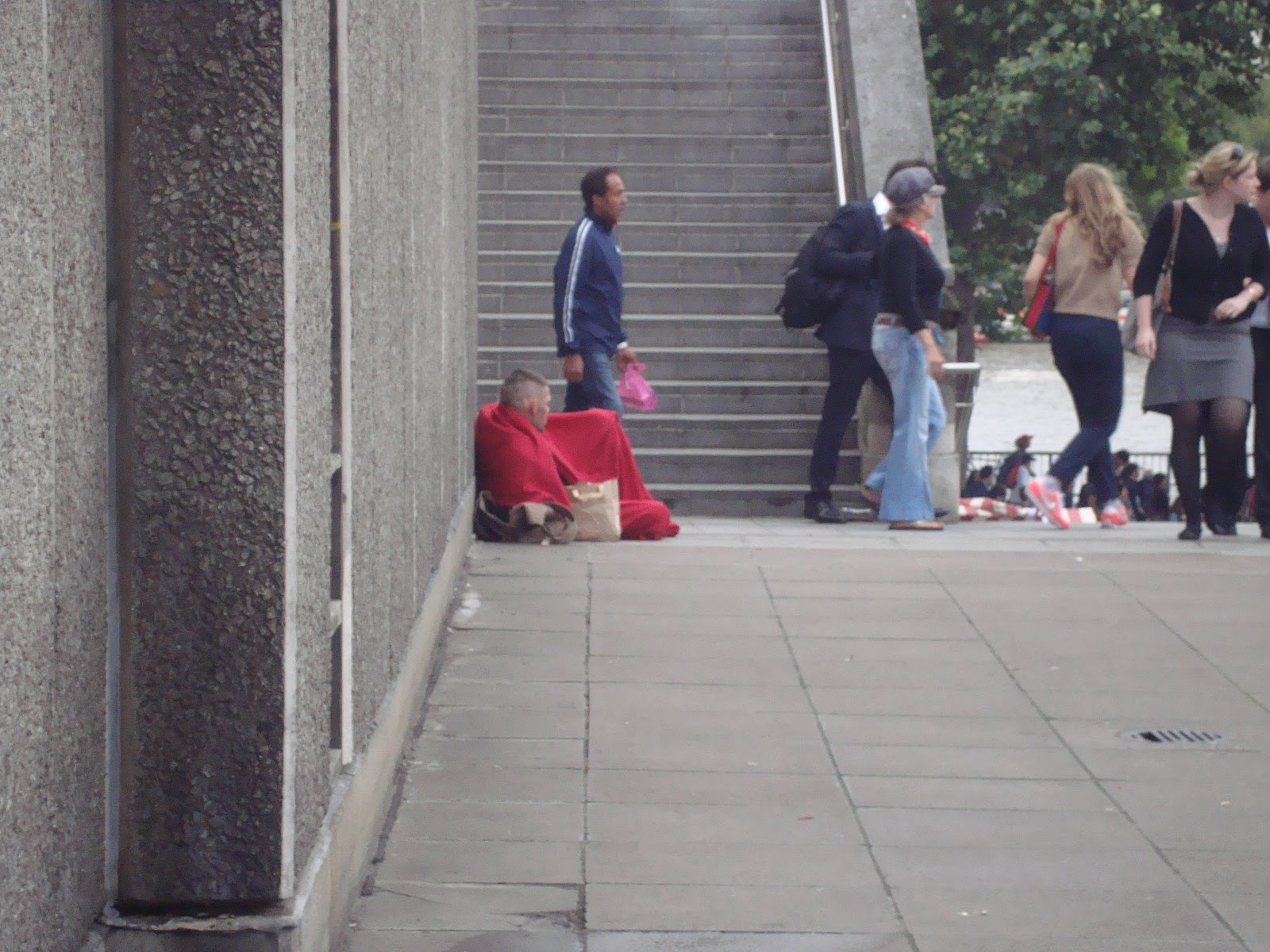
They don't exist in the catalogue versions of the city. You never see them on BBC or TripAdvisor's coverage of London. Jet-setting friends return without ever making any mention of them, yet in the actual city you come across these homeless everywhere. They are nowhere near in number to the throngs of beggars that crowd the traffic signals of Lahore, but the impact of their loneliness, guilt and visibly broken spirits is somehow greater on the soul. Perhaps because the beggars in Lahore are usually assertive, soliciting money actively, even aggressively, tapping on car windows with force, sometimes even throwing the coin right back at you if it doesn't live up to their expectations. In London they just huddle on the edge of a tube station or street corner trying to shield themselves against the city's cold evenings, feebly calling out to passersby for a coin; many too ashamed to attempt even that. They invariably wear a far away, glassy look and an acute sense of having failed in a world that lays so much premium on winning. It is perhaps the contrast with their surroundings that makes their plight more readily moving, or it could be my personal immunity to the everyday sufferings of our own poor, part of an endemic cycle of injustice and hardship that everyone but the very elite are protected from. I fear romanticizing their plight, but in Lahore, beggarwomen often form a curbside community of females more loose-limbed than their middle class counterparts, their children tearing about on roundabouts, fighting and sometimes laughing amongst themselves, living some form of community on the very fringes of society. London's homeless, however, exist in complete isolation.


On Millennium Bridge

Holborn. I could have taken another, less fuzzy picture, but it seemed callous to let him catch me photographing him, so I just made do with the first click. The manner in which he just sits there conveys enough.

Behind Embankment

A woman sleeping on the pavement near King's Cross Station
Waterloo bridge
Tottenham Court Road
Southbank


Saturday, March 3, 2012

A new golden age of Pakistani drama? Think not

A Pakistani drama serial has brought the nation together once again, reminding people of the ‘80’s when ‘Waaris’ and ‘Tanhaiyaan’ are fabled to have left the streets of Lahore deserted.
Pakistani drama had been witnessing a revival for a couple of years now, but not until Humsafar did that scattered babble converge to a deafening roar; confronting the unsuspecting on every corner regardless of consent. It is the kind of all-encompassing popularity that legends are made of, and who but the shallowest snob would begrudge such a culturally defining moment?
So, to bring myself up to speed, I decided to spend one weekend on YouTube catching up on the Pakistani zeitgeist. Closing the dozen or so windows that are usually open on my Chrome at any given time to allow my computer optimum performance and speed, I settled down to plug into the pop-culture rhythm of modern Pakistan.
It didn’t begin very promisingly. The principal characters were immediately defined through tired old tropes of class —poor girl with chadar equal to good and chaste; rich girl in jeans, spoilt and forward. Add to that the poverty-stricken but upright mother on her death bed and (the soon to turn into) evil NGO-aunty mother-in-law, and every tired old cliché in the Pakistani moral universe begins to gnaw at whatever little substance the play had to begin with. These said characters then proceeded to act in the way the middle class writer’s imagination perceives poor people act, or equally rich ones. The women orbitting in their pre-determined paths around the intense and manly object of desire whose taut face and pregnant pauses helped drive the contrived ‘plot’.
While the female characters are painted through a Nazeer Ahmed-esque moral lens of angelic goodness and devilish design, the man’s agreeableness remains superfluous to his desirability, perhaps even detrimental to it; his unreasonable suspicions proof of his virile masculinity.
Sarah, who in the first fifteen minutes is presented as the demure sidekick in Asher’s business, suddenly discovers a histrionic streak that would put Malka-e-Jazbaat, Bahaar to shame.
That there are women who might choose to behave like Sara when they find out that the love of their life is betrothed to another is not under doubt, neither is the fact that there are women like Khirad who could be led into marrying a stranger because they have no other option; the problematic bit is that all Pakistani plays across the board depict most ‘lovable’ female characters in this light. This is their idea of what people want, and with the unprecedented success of ‘Humsafar’, it seems like they’ve got it right. 
The play’s popularity amongst the well-to-do, private school educated classes is the most fascinating aspect of this phenomenon. It is possible that the main reason for it is the charisma of Fawad Khan and the dewy faced Mahira, at least if my class full of 15-year-old girls is any proof, but our perverse obsession with suffering is also another plausible reason for its success. Suffering women in particular seem to be placed on a pedestal; by men because they are the ultimate romantic symbols of womanly sacrifice, by women because it is nice to be validated on screen for life choices that have them personally unfulfilled but socially approved.
Humsafar’s popularity is sad evidence of the systemic erosion of Pakistan’s social consciousness since the enforced piety of Zia’s days. If Haseena Moin was the benchmark of mass popularity back then, then Humsafar in as indicator of our endemic regressiveness. The sad irony is that Haseena’s heroines challenged the status quo by being their bubbly, independent, if hopelessly romantic selves; in comparison, the Khirads and Sarahs of today are a firm step backward. Those earlier women had time to be just women, with humour, grace and tenacity that lent texture and authenticity to their characters. Today’s specimens perpetually shuffle from one tear-jerker to another; their whole lives one long, painful dirge on the hazards of being a woman in a patriarchal world they have no interest in challenging or shaping. Sassy, single women of the 'repressed' 80’s (think Badar Khalil in Tanhaiyan) had the wherewithal to support two grown-up, orphaned nieces without any of them being played for the ‘bechaari’ sentiment that drives most depiction of women today. Besides, female friendship was celebrated, whether amongst college friends, sisters or between aunts and nieces. The Sarah and Khirad model inevitably pits them against one another, rendering them useless without the pivotal man in the middle.
Today’s plays, including Humsafar, are much like Razia Butt novels, just having shifted mediums from the inside pages of a women’s weekly to the 8 o’clock slot on television. Only through this switch the impact of their regressive mindset has widened considerably, entrenching our society’s stereotypes ever more solidly into our consciousness.


First published here on Dawn.com

Monday, October 31, 2011

MayN tau DekhooN Ga

A fellow-volunteer at TCF (The Citizens Foundation) asked me yesterday if I was going to the PTI rally. My first reaction was to laugh, and then wonder, 'Women go to political rallies?' Perhaps what I really thought was 'Do women like us go to political rallies?' 'Us' being 'shareef' and middle class, belonging to families who may have acquired almost-elite status over time, but whose middle class values dictate that the arena for women's political participation be the family's television lounge, not the uncertain grounds of Minar-e-Pakistan.

By the morning the momentum was clearly palpable on my Twitter timeline. I have always been ambivalent about Khan's politics but I am also a sucker for a 'mela' and this was promising to be a carnival like no other. Despite trepidation at braving such crowds on my own, I went out driving alone and joined the PTI caravan at Kalma Chowk, buoyed by the hope that harassment of women might figure low on the agenda of willing attendees of a rally for change. The optimism wasn't misplaced, for the most part. The Lawyer's Movement had brought the burger crowd to the streets before, but this felt different. For many of those following the caravan from Defence and Model Town, just going to Minar-e-Pakistan was an act of immersion and solidarity with the general populace, and a form of political awakening. Jeans and maila kurtas all powering forth in one direction.
Encroaching on PPP territory?
It was certain by this time that the gathering was going to be huge. People around me made victory signs atop buses belonging to private local colleges. Cars played Amanat Ali Khan's 'Ae Watan Pyaare Watan' but the most ubiquitous song remained 'Jazba Junoon', blared constantly from the leading truck in the procession. I wondered if other political rallies ever use music from a Pakistani rock band, and whether I was imbuing this act with too much meaning. But to children of Zia's era even small signs of 'progressiveness' are cause for some celebration and relief. This pop music motif continued till the end, an obviously deliberate attempt to soften the 'Taliban Khan' image and to keep PTI's strong youth base harnessed.

Not exactly voting age
I saw many of my Aitchison students along the way, most of whom will turn 18 next year. This means none of them is a potential voter because they are not eligible for vote registration yet. They couldn't have formed even one percent of the total number in the rally, but their presence did reinforce the Zohair Toru stereotype in my mind, possibly because I knew most of them personally. A democracy, however, for good or for bad, does not differentiate between a Zohair Toru and an Ardeshir Cowasjee

Aitchison's most illustrious son?
Upon reaching Oriental College, Punjab University, I parked my car inside (privileges of being the ex-Principal's daughter) and joined some friends in theirs. It was their first time at such a rally and the three middle-aged sisters had much of the well-intentioned, wide-eyed political naivette that seems to be the hallmark of the PTI supporter. Traffic was so choked by the time we reached Karbala Gamay Shah that we had to walk the last mile to Minar-e-Pakistan, carried along by the crowd's thrust. Some boys in front of me made suggestive thumkas and burst into raucous laughter at their own cleverness. On the other side men danced and marched to the beat of dhols while we weaved our way through the crowd amidst shouts of 'Let the ladies pass!'

Marching on to Minar-e-Pakistan
Once we reached the ground and had squeezed our way through to a decent position, it became impossible to see a panoramic view of the crowd, so it was not possible to make any kind of guess as to crowd numbers or even to take it all in in one sweep. One could only tell that there were thousands of chanting people on every side and Manto Park was so full that it was not possible for anyone to try and squeeze their way out of the stadium.

The crowd around me was impatient with the speeches of 'irrelevant' PTI leaders and its only interest lay in hearing Imran Khan, constantly chanting his name to urge him along. While this one-man-show has often been touted as a major drawback in Imran Khan's chances, I don't see it as a particular hurdle in a country where the politics of personality cult ensures people vote for Bhutto even thirty years after his death. Where the populace does not know the names of the candidates but votes for 'teer' or 'sher'.

Strings came on for one song to boost sagging morales. Half-way through 'Mayn tau dekhooN ga' I fished for the PTI flag someone had thrust in my hand earlier and I had promptly discarded under my chair, and waved it in thumping rhythm to Strings' lyrics; for that moment one with the crowd and just as starry-eyed and hopeful as them. For who so hard-hearted that can resist the adrenaline-pumped optimism of thousands of people singing along to 'Woh din phir aae ga jab aisa ho ga Pakistan', 'jab roti sasti ho gi aur mehngi ho gi jaan', 'jo duur gae thay bhoolay se, lotayN ge phir watan ko aek shaam' (this last one particularly makes me misty-eyed).

Here's my rather dizzying capture of the above with an extremely basic digital camera. If you make it to the end please also pardon my out of tune singing along.


Imran Khan finally took to the stage at around 7 in the evening by which time the crowd was getting increasingly agitated and several women and children were trying to unsuccessfully make their way out. The crowd, however, was too thick to allow anyone to pass through. Imran took the mike amid a deafening roar. His cricket analogies prompted gleeful high fives from the boys in front of me while those at my back chanted 'Jab tak sooraj chaand rahay ga / DJ Butt tera naam rahay ga' upon Imran's mentions of DJ Butt--again I suspect, a deliberate attempt to identify with a youthful, pop-oriented figure. Sound strategy, I feel, of juxtaposing Islamic rhetoric with identifiably popular elements of youth culture.

Mehmood-o-Ayaz
The speech was full of feel-good optimism as was expected and required. Talk of corruption, delivering rights to the poorest in the society and anti-Zardari sentiment elicited the most visible roars of approval. Personally speaking, I was disappointed at his resorting to lies about Hussain Haqqani's nationality but heartened by his passing mention of minority and women's rights.


The Lit Minar


I came away feeling that Imran's never-say-die philosophy seems to be paying off once again. I made yet another mental note to get my vote registered the next day. If I manage that, I will be voting in the next elections for the first time in my 33 years. And that right there is a victory for Imran Khan.


-----------------------------------------------------------------------------------------------------------

The Faces

ET bloggers?

Aunties still have it for him


What's a third world anti-Imperialist revolution without its own Che?


Could that be the enigmatic @Kaalakawaa in a Stanford tee?
The new poster-boy for PTI
(Our dear @TheRealYLH turns lota)


Friday, January 7, 2011

Winds of Change?


The candelight vigil for Salman Taseer held outside the Governor House in Lahore can perhaps be deemed a success, depending on your perspective. Blogger Raza Rumi claims on Twitter that around 2000 people attended, that figure leaves me entirely surprised. I didn't do a head count but surely it seemed much less than 2000. The last protest i attended after the Swat flogging video was released had a far greater number of people participating and they also seemed to be from a wider cross-section. Today it was the usual suspects. LGS Principals, NGO aunties and other fashionable members of civil society who have now (understandably) diverted paths with the lawyers they stood up for a short while back. The biggest turnout you saw from the civil society was during the Lawyers movement, the vigil for Salman Taseer came nowhere near that.

I don't say NGO aunty or the 'fashionable' in a necessarily derisive way, it is just that a handful of these people, many of whom must have personally known the slain Governor aren't really representative of any fictionary 'silent majority'. The only scarf I saw was on the very left wing head of Daily Times op-ed Mehmal Sarfraz. The rest were all streaked. Don't mind the over simplification, but I just point out the obvious physical appearances to drive home a point. While 'Mulla gardee naheen chalay gi' on the top of my lungs helped me vent some of my pent up frustration at being a citizen of a state where my religion will always be the business of everyone else, it didn't really do anything to increase my hope in the prospect of a budding liberal Pakistan.

I know enough of the mindset of the majority to be certain that jeans clad, streaked, English spewing lads and ladies will be immediately dismissed as 'dehriyay' and 'laa-deen'. Once one is dismissed as that there is no further room for another nuanced analysis. It is a class thing, and today's vigil, though an extremely essential step, whether or not it has any far reaching implications, is ultimately just another exercise in Pakistani class differences. There were of course PPP workers as well, but where was the vast majority of the 'average' man. Half of those condemn the act of killing but would never be able to raise their voices to the chant 'Mazhab ke naam pe siyaasat band karo'. (Stop politics in the name of religion), while the other half is busy throwing flowers at a ruthless murderer.


I must add, though, that I WAS heartened at the number of women present.

I wish the vigil had been held at the Liberty Market roundabout, though, for at least that would have helped in creating greater nuisance value.

Perhaps a better assessment of the general public's views was to be had from two pedestrians who were marvelling at the 'be-hayaaee' of those participating in the vigil.

The biggest show of bravery I saw, interestingly, was not outside the Governor's House. I rushed from the vigil to pick my son up from a classfellow's birthday and on my way to Defence I saw this car. I am sure this person did not participate in the vigil, so it was nice to see that similar sentiments were being expressed elsewhere as well


But, the most heartening part of the day was neither of the above events, it was what I saw in the morning that truly delighted me. I saw two young girls riding a motorcycle bang in the middle of Gulberg, a little nervous, yes, but for the most part quite confident. They did not look like they were from the privileged set who can get away with most anything, but the one sitting behind was wearing a black coat and trousers while the one driving was in more traditional clothes. It was quite a sight to behold. Most men around them seemed too stunned to even try to harass them. As luck would have it, i was driving, so I was unable to get a clear picture. But perhaps it is just as well that you cannot see their faces and can just sense their joy. (I really hope, for the sake of my romantic imagination that they reached home looking just as happy).